AI-assisted engineering
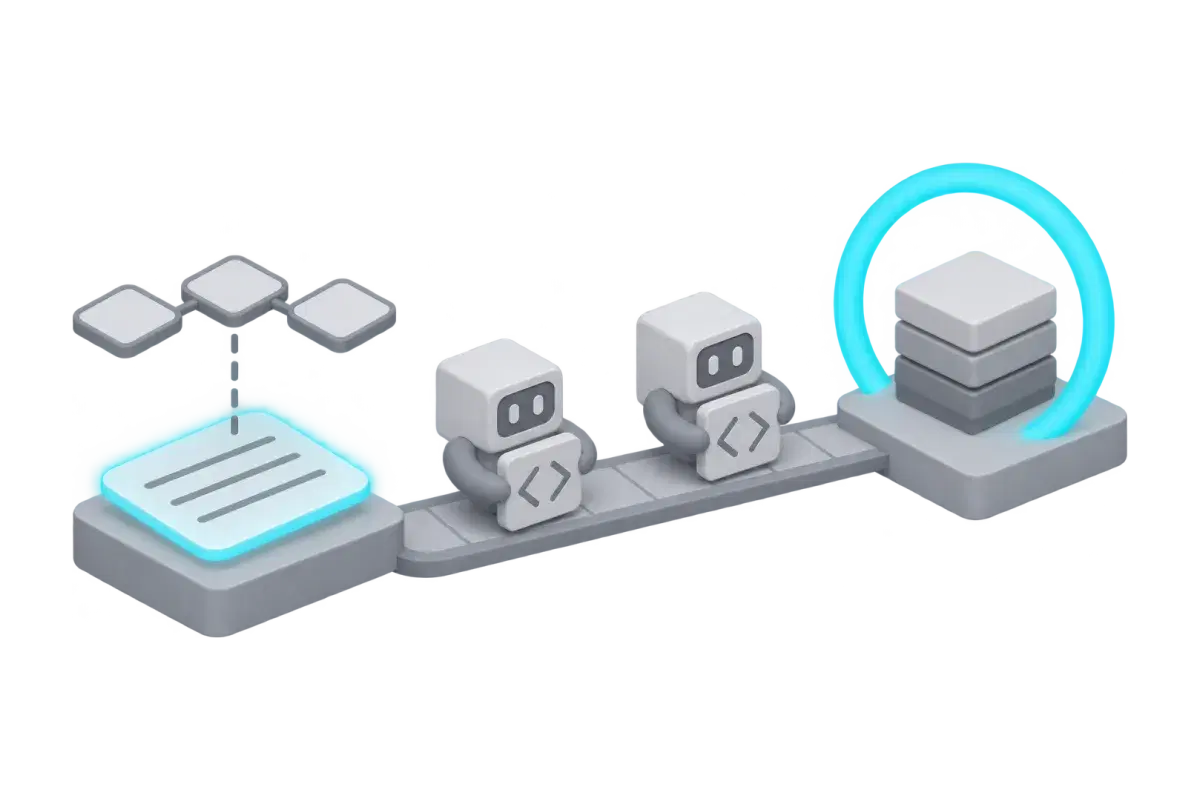
Coding agents write more code, but teams don't finish more features. This engagement rolls out a plan-first workflow on the agents you already use: your people agree the plan, agents build and check it in small slices, and a person reviews the finished change.
What's included
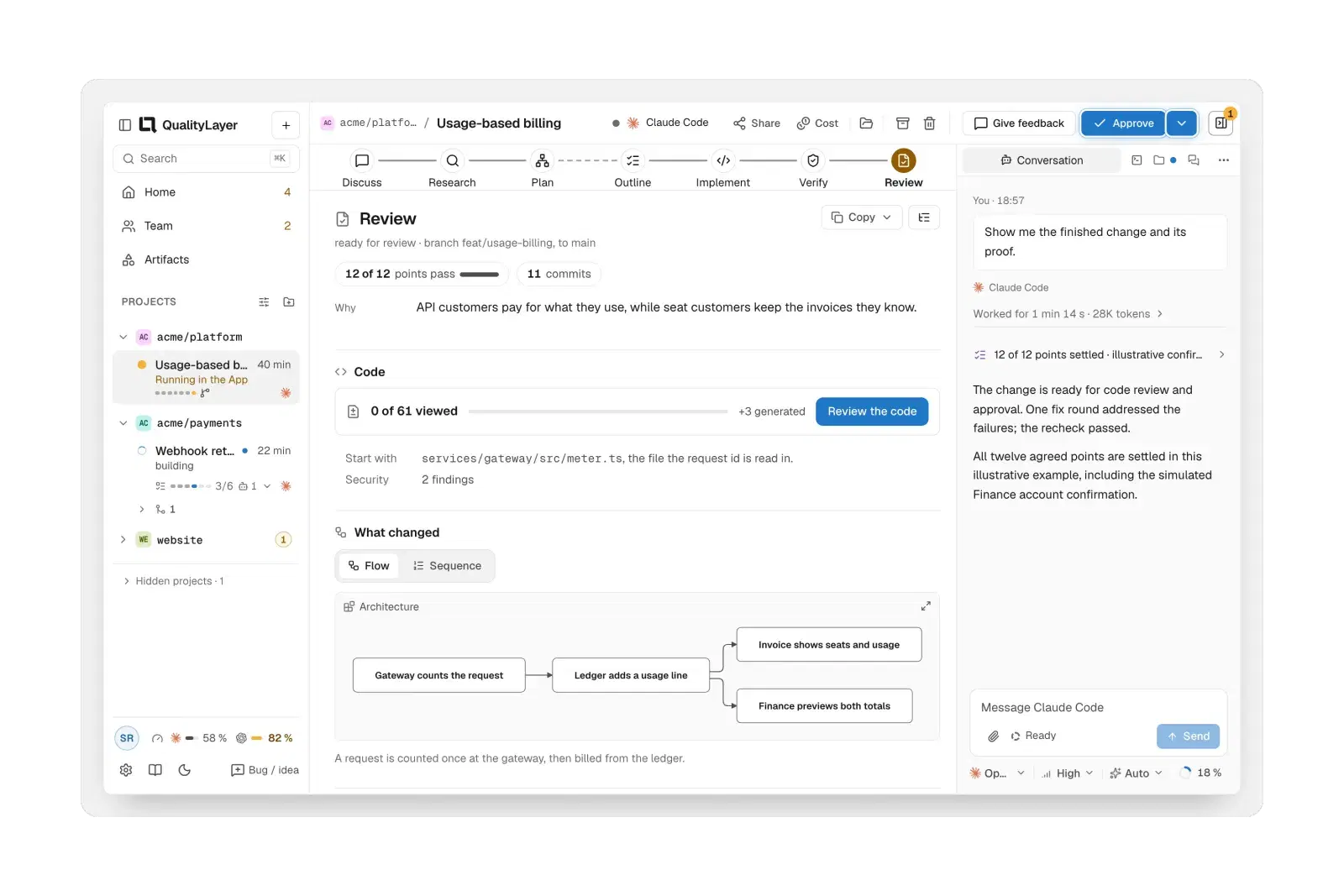
- A plan-first workflow in your repositories. Every change starts with an agreed plan: what it is for, how it fits your architecture, how the code is structured and which small slices it ships in.
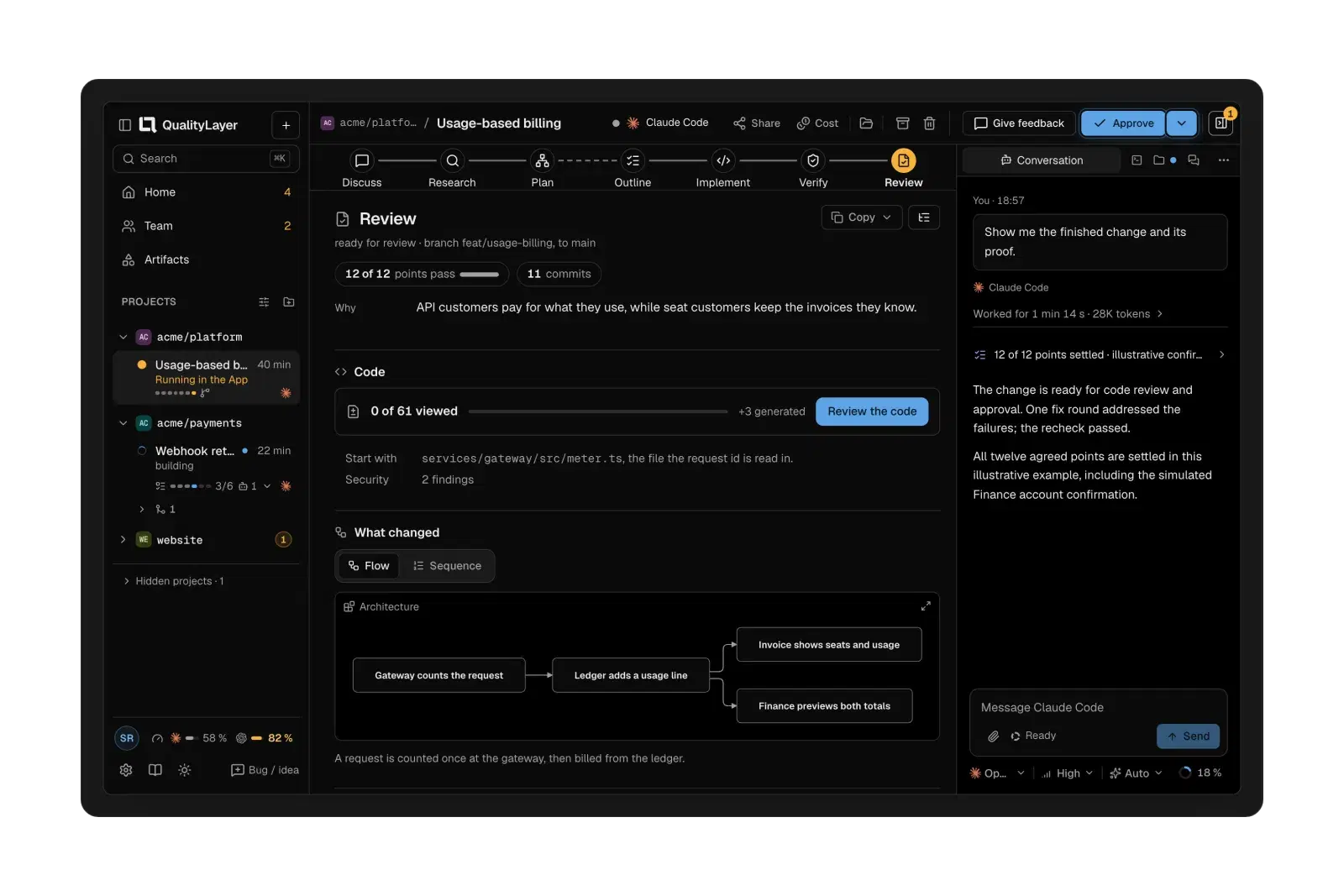
- QualityLayer as the default tool. It runs on your own computer with the agent your team already uses, and keeps each step as a markdown file in your repository. Connected agents can ask each other for a review, such as Claude Code asking Codex. Your team licenses it directly at qualitylayer.dev (opens in new tab); we set it up and tune it to your stack.
- Checks on every change. Tests and types, linters, code-health checks and security scans, then an independent reviewer agent that did not write the code, with an optional second opinion from another coding agent. Every point needs recorded evidence before a person looks at the result.
- Your team at the two points that matter. Teammates join at the plan and at the finished change through comments and share links, so the person who knows the area makes the call.
- Training on your own backlog. Your team runs the workflow on tasks it already has planned, and we pair on the first ones until it holds without us.
What the studies show
More code, the same number of finished features
Coding agents raise output. Three studies from 2026 show where the extra work ends up: in review queues, in incidents and in code that gets harder to change.
- Longer time to merge a pull request, with no measurable change in finished features.
- +49%
- Source Chen and Stratton, Harvard, "Artificial Intelligence in the Firm", 2026. Jellyfish data from 700 companies.
- More incidents per pull request as teams adopted AI coding tools.
- +243%
- Source Faros AI, "The Acceleration Whiplash", 2026. 22,000 developers; a correlation, not proof of cause.
- Stages where the best model built the new part and kept everything else working.
- 1 in 6
- Source SlopCodeBench, University of Wisconsin-Madison, 2026.
- Runs where the code's structure got worse as the agent kept building on it.
- 77%
- Source SlopCodeBench, University of Wisconsin-Madison, 2026.
How we got here
Eighteen months of agentic coding
Each stage fixed a problem of the one before, and most of them moved people further from the work. The latest brings them back in where their judgment costs least.
Jun 2025
Plan mode
Claude Code
The agent writes a plan before it codes. You approve it and hope the code matches.
Jul to Sep 2025
Spec-driven
Kiro, GitHub Spec Kit
Specs become files in the repo, so the plan outlives the session.
Oct to Dec 2025
Workflow frameworks
Superpowers, Pilot Shell, GSD
Rules, hooks and tests first turn good habits into steps the agent must follow.
Dec 2025 to Jan 2026
Loops and graphs
Ralph loop, Beads, Gas Town
Agents run in loops and pass work to each other through task graphs.
Feb 2026
Lights off
StrongDM
Agents build, review and ship around the clock. Nobody reads the code.
May 2026
Goal mode
Claude Code, Codex
You set a goal and the agent keeps going until it judges the goal met.
Oct 2026
Humans in the loop
QualityLayer
Agents build and check. People decide at the plan and review the finished change.
A factory without people ships the average. Taste, knowing the customer and deciding what not to build still come from your team.
Decide at the plan, review the finished change
A bad design decision rarely shows when it is made. The tests pass in seconds. Weeks later a one-line change takes eleven edits, and months later there is an incident nobody traces back to the plan. Where a mistake gets caught sets its price: in the plan it costs a comment, in code review a rewrite, after release an incident and the rewrite.
So the workflow we roll out puts people where their judgment is cheapest. Before any code, the team agrees what the change is for, how it fits the architecture, how the program is structured and which slices it ships in. Agents then build those slices test first, checks and a fresh reviewer agent go over the result, and a person reviews the finished change before it becomes a pull request.
We have vast experience on the organizational side before: evaluating GitHub Copilot and Amazon Kiro (formerly AWS Q Developer) for a platform team's day-to-day work, building an MCP-backed CLI agents toolkit wired into GitLab, Confluence, Jira and SonarQube, and sharing what worked, and what didn't, across a large DevOps community. We have been there ourselves, navigating the challenges and opportunities of agentic coding in real-world settings with Governance at scale.
Engagement models
Ways to work together
Whether you need a second opinion or a hands-on partner, there is a model that fits how your team works.
Advisory
For teams already using coding agents that want a second opinion on how they plan, check and review agent work.
€220/ hour
- Review of how your team uses coding agents today
- Where the plan and review points belong in your process
- Async access for questions
- Pairing sessions on real tasks
Workflow rollout
Most popular
A scoped rollout of the plan-first workflow in one team's repositories, until the team runs it without us.
Fixed bid
- QualityLayer set up on your agents and repositories
- Tests, linters and reviewer agents wired into every change
- Team training on plan, build, verify and review
- Handover notes and a runbook for new teammates
Embedded
An ongoing partner while the workflow spreads from one team to several.
Custom
- Dedicated weekly capacity
- Rollout across teams and repositories
- Checks and reviewers tuned as your codebase changes
- Quarterly review of what reached production and why
Frequently asked questions
Looking for the delivery, cost, and reliability engagement instead?
Cloud-Native Solution Engineering
DevOps, FinOps, and SRE as one engagement - delivery, cost, and reliability measured with DORA.
Ready to ship faster on AWS?
Tell us what you are building. We will map the fastest safe path to production and the platform to keep it there.